
The Next Intensive October 19-22nd
I'm Amber — and I've spent 20+ years learning something most families never get taught: how people in denial actually think.
I specialized in working with resistant, defensive clients who didn't want to be in the room with me. People everyone else had given up on. I learned to speak their language, understand their fears, and motivate them to change — without confrontation, without ultimatums.
Now I teach families those same insider strategies.
Not so you can enable them. So you can influence them.
This isn't about having more compassion or understanding their pain. It's about understanding their psychology so well that you know exactly what to say — and what not to say — to break through denial.
Most programs teach you to detach and focus on yourself. That works for some people.
But if you're not ready to give up? If you believe they can change with the right approach?
This 4-day intensive is for you.
Secure Your Spot for October 19-22
Why Denial Isn't Stubbornness—It's Self-Protection
You've tried everything — talking, reasoning, setting boundaries, maybe even ultimatums — but nothing gets through. Every conversation either turns into a fight or they shut down completely.
Here's what most people don't understand: their denial isn't stubbornness. It's a defense mechanism — and the harder you push, the stronger it gets.
To everyone on the outside, things might even look fine. But you see the truth. You see the dropped balls, the broken promises, the cracks in the foundation no one else notices.
And here's the hardest part: every time you try to point it out, you accidentally make the denial stronger.
The Real Problem: You're Accidentally Reinforcing Their Denial
Here's what most people don't realize: every time you confront them with criticism, you're actually making the denial stronger.
When you point out what they're doing wrong — the missed commitments, the broken promises, the ways they're letting everyone down — their brain immediately goes into defense mode.
And even if they don't say it out loud, they're thinking it.
"She's overreacting." "It's not that bad." "I work hard — I deserve to unwind." "If she would just get off my back..."
Every time they defend their behavior — even silently, in their own mind — they're convincing themselves there's no problem.
This is called reactance theory. When people feel pushed, controlled, or criticized, they push back harder — even against things that would actually help them.
Worse, they start to believe you're the problem. Not the behavior. You.
Now they're preoccupied with feeling attacked, misunderstood, and controlled — which keeps them from ever looking at what's really going on.
This is why nothing you've tried has worked. Not because you're doing it wrong. Because confrontation — no matter how valid your concerns — will never break through denial. It only reinforces it.
The Denial Breakthrough Intensive teaches you a completely different approach...
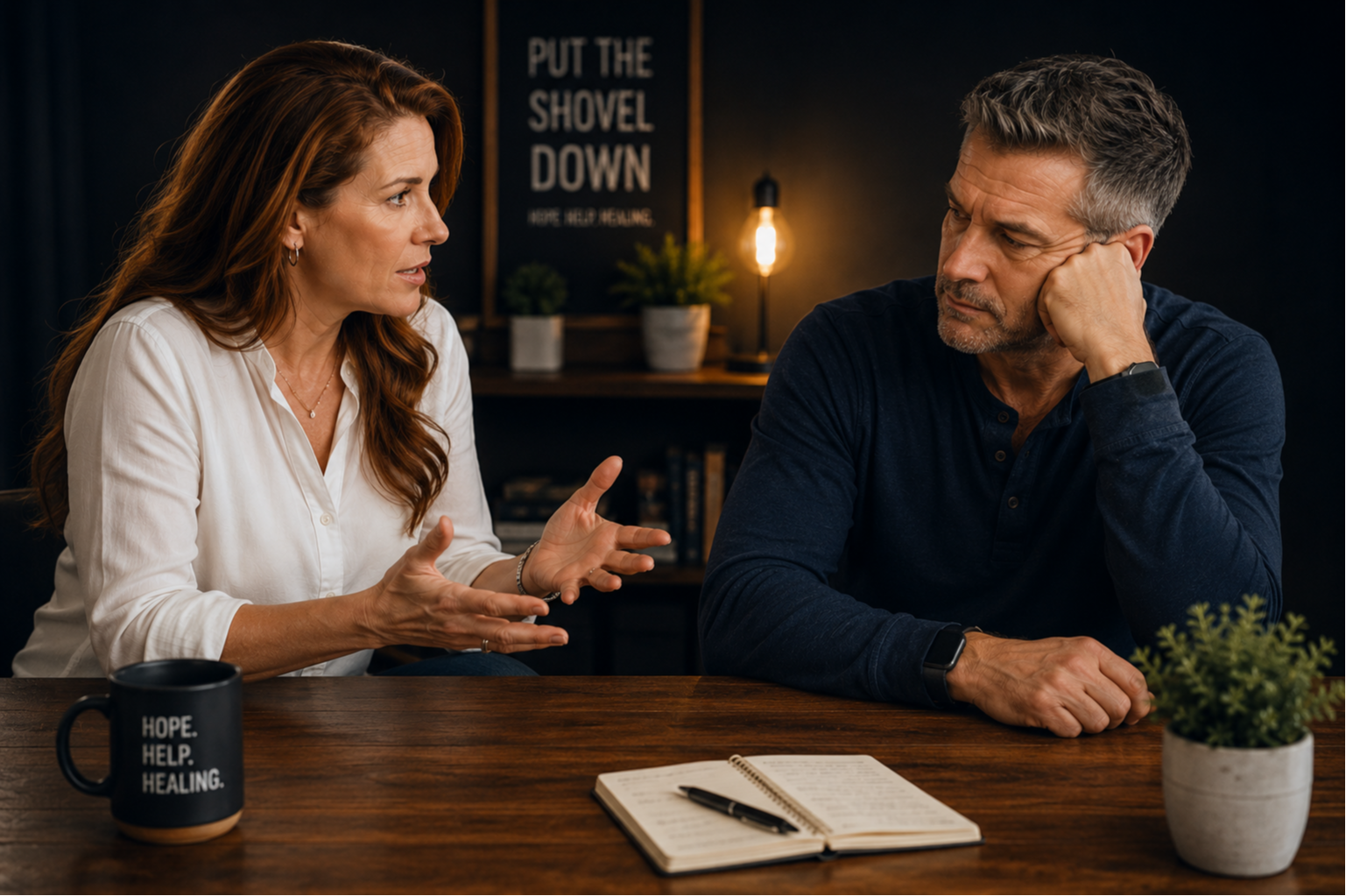
What If You Could Break Through Their Denial — Without Them Even Knowing You're Doing It?
That's exactly what The Denial Breakthrough Intensive teaches you to do.
Instead of pointing out their failures, you'll learn how to reflect back their values, their identity, and who they want to be — so they start to see the gap between the person they are and the person they're becoming.
Instead of creating defensiveness, you'll learn how to create curiosity — about themselves, their choices, and what's really going on.
Instead of making yourself the enemy, you'll learn how to step back with confidence — while strategically illuminating the problem in ways they can no longer ignore.
You're not convincing them they have a problem. You're not nagging, threatening, or waiting for rock bottom. You're simply holding up a mirror — using their own words, values, and past victories — so the truth becomes impossible to deny.
And the best part? They think it's their own realization. Because it is.
Over 4 days, you'll learn exactly how to do this, step by step.

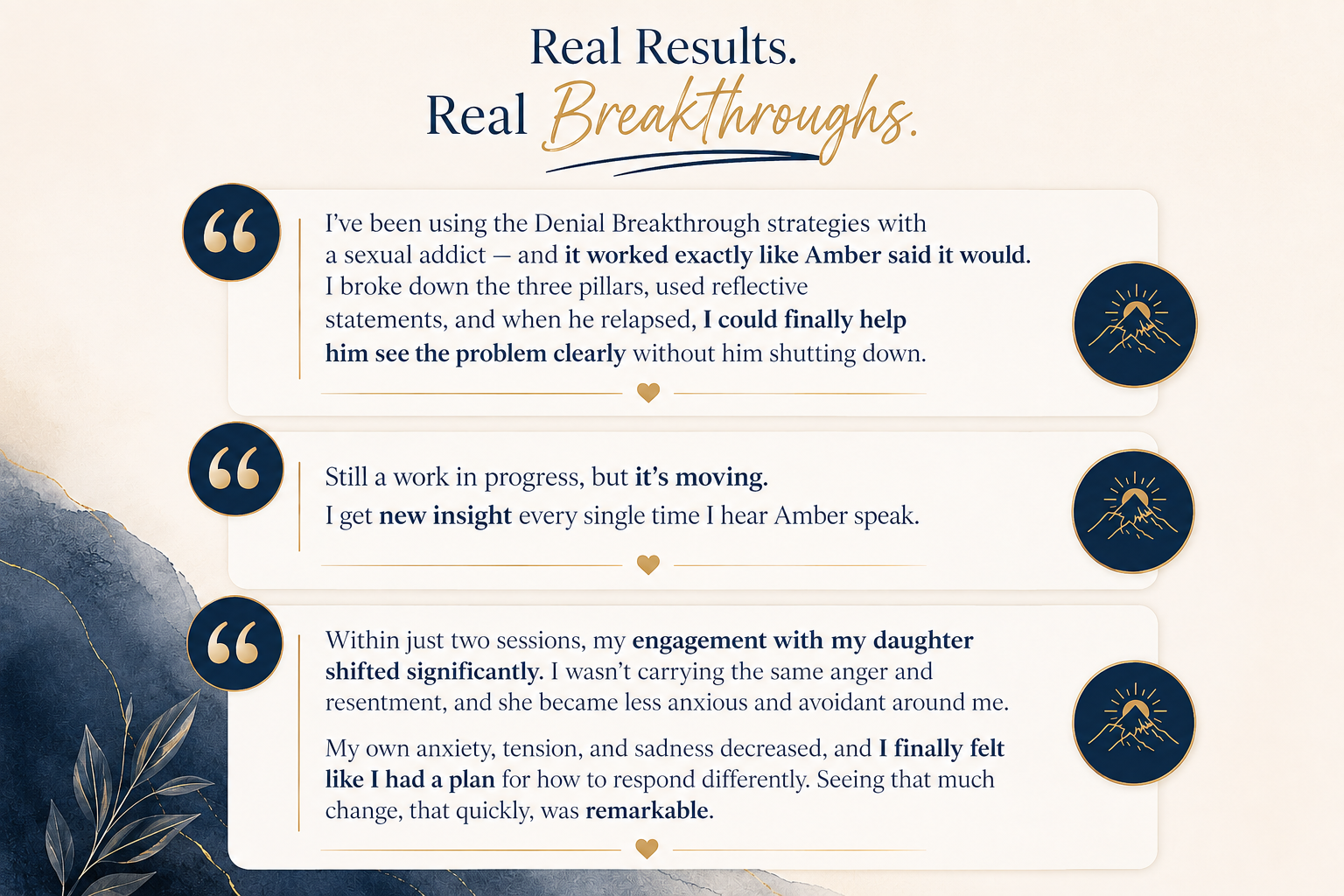
"She started noticing things herself"
Mark's wife insisted she didn't have a problem—she was "just stressed." After he learned the mirror method in Week 1, she came to him three weeks later and said: "I think I need to take a break from drinking. It's not helping.
He didn't have to convince her. She convinced herself.

"He asked ME what I thought he should do"
Sarah's husband was in complete denial for 2 years. Every conversation ended in a fight. After just Day 3 of the challenge, he turned to her at breakfast and said: "I've been thinking about what you said. What do you think I should do about my stress?"
This was the first time in 2 years he'd asked for her input without getting defensive.

"The wall came down"
Jenni had been walking on eggshells for months. After learning the energy shift technique on Day 4, her partner's entire demeanor changed. "It was like he could finally breathe around me again. We talked about his drinking for the first time without him shutting down.
These aren't lucky breaks. This is what happens when you stop fighting against denial and start working with human psychology.
Join The Denial Breakthrough Intensive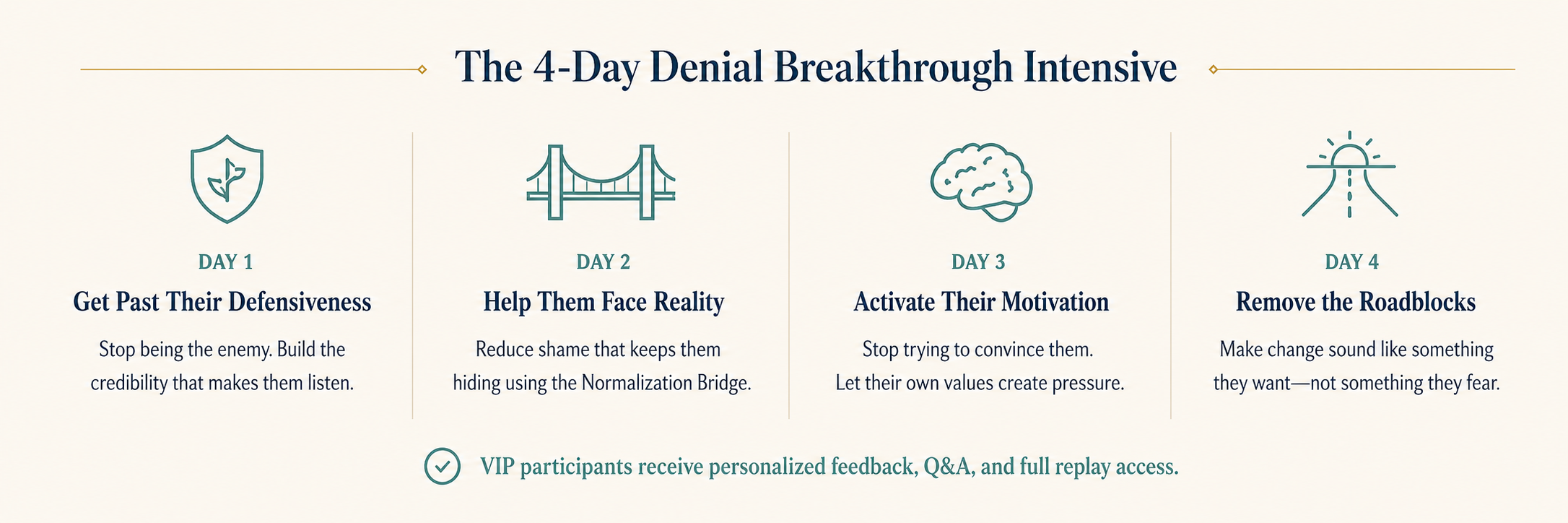
VIP Risk-Free Guarantee 🛡️
I'm so confident in the Denial Breakthrough Method that I'm offering VIP participants a 100% money-back guarantee — but with one important condition:
You have to actually show up and do the work.
Here's the deal: If you attend all 4 VIP Q&A sessions with your camera on, complete the daily assignments, and genuinely apply what you learn — and you still don't feel like this intensive gave you clarity, tools, and a path forward — I'll refund your investment in full.
Why these requirements?
Because this method works — but only if you engage with it. I can't help you break through someone else's denial if you don't break through your own resistance to trying something new.
This guarantee is only available for VIP participants because the intimate group format and personalized feedback require your active participation to deliver results.
To request a refund, simply email [[email protected]] within 48 hours of the final session with proof of attendance and completed assignments.
Meet Amber: The Woman Who Spent 20 Years Getting Through to People Who Didn't Want Help

For over 20 years, I worked as a Licensed Counselor specializing in something unusual: getting through to people who didn't want to change.
Most of my career was spent with clients who were resistant, defensive, in denial — people who didn't want to be in the room with me. Through thousands of sessions I developed a unique ability to break through walls that everyone else said were impossible to break through.
The insight that changed everything:
The secret to lasting change isn't telling someone what to do. It's understanding how they think — and helping them want to change. That became my specialty.
I learned to speak their language. Understand their fears. See what they were protecting. And use that insider knowledge to motivate transformation — without confrontation, without force.
Why I created the Denial Breakthrough Intensive:
For years, families would ask me: "How do I get through to them?" And I'd watch them do everything wrong — not because they didn't care, but because no one had taught them the psychology I'd spent 20+ years developing.
So I created this intensive to give families the same insider strategies. Not to enable. To influence.
My track record:
- Creator of the Invisible Intervention framework, used by hundreds of families
- Founder of Hope for Families Recovery Center
- 900,000+ subscribers on YouTube
- Keynote speaker
- 20+ years specializing in resistant, defensive clients who didn't want help
This isn't just theory. It's what actually works when nothing else has.
00
DAYS
00
HOURS
00
MINS
00
SECS
Is Your Situation the Right Fit?
For years this intensive was built specifically for spouses of functional alcoholics. That was my world — 20+ years working with resistant, defensive clients who didn't want to change, and the families who loved them anyway.
But something kept happening. People started applying these techniques to other situations — and they kept reporting back: it worked.
That made sense to me clinically, because this methodology was never really built on addiction psychology. It's built on human psychology — specifically, how people in denial think, and what actually moves them. Addiction just happened to be where I developed and tested it.
Here's what I've come to understand after 20+ years: addiction isn't just about substances. It's about a neurological pattern — dopamine reward cycles, intermittent reinforcement, and a growing gap between who your loved one believes themselves to be and what their behavior is actually doing to the people around them.
That pattern shows up in a lot of places:
- Alcohol or substance use
- Gambling
- Pornography
- Spending or financial irresponsibility
- Workaholism
- Affairs or serial infidelity
- Video gaming
- Social media obsession
- Helping someone you love see they're in a toxic relationship they can't see clearly
- Any compulsive behavior that started serving a purpose but is now causing real harm
What all of these have in common is this: the behavior started serving a purpose — relief, escape, excitement, control — and now it's causing harm. But the person caught in it can't see it clearly enough to stop. And the harder you push, the more they defend it.
That gap between what they know and what they're willing to face — that's exactly where this methodology works.
That said — this isn't a universal tool. It won't work in every situation.
It works less well — or won't work at all — when:
- The issue is a preference, not a problem. If your loved one's behavior isn't causing genuine harm and you're primarily frustrated by differences in personality, lifestyle, or habits, this isn't the right tool. This methodology is designed for situations where something genuinely needs to change — not to help you get someone to be tidier, more ambitious, or more like you.
- They have a serious mental illness where denial has a neurological component — bipolar disorder, schizophrenia, or similar conditions may require a different approach entirely.
- You have very limited contact with them. These techniques work through repeated, everyday interactions. If you rarely see or talk to them, you won't have enough opportunities to apply what you learn.
- There is a safety issue. If you're in a situation involving physical abuse or any threat to your safety or your children's, please prioritize getting professional help first.
The person this works best for is someone whose loved one knows on some level that something is wrong — but avoiding it feels safer than facing it. That's the denial this method is designed to break through.
If that sounds like your situation, you're in the right place.
Can I pull this off?
✅ This intensive is perfect for you if:
✓ You have regular contact with them (these techniques work through repeated, everyday interactions — they won't be as effective if you rarely see or talk to them)
✓ You can see the problem clearly — even if no one else does (they may still be functioning, keeping up appearances, but you see the cracks)
✓ You have some emotional bandwidth (you don't need to be at 100%, but you do need enough energy to engage with focus and stay strategic)
✓ You're ready for strategy, not just support (this teaches you HOW to influence them, not just how to cope)
✓ You believe they can change (even if they don't see the problem yet — you believe it's possible with the right approach)
✓ You're ready to take action (you want practical tools you can start using immediately, not just theory)
✓ You can stay calm under pressure (these techniques require patience and intentionality, especially when it's hard)
❌ This intensive is NOT for you if:
✗ You have very limited contact with them (if you rarely interact, you won't have enough opportunities to apply what you learn)
✗ You're in an unsafe situation (physical abuse, severe emotional abuse, or any threat to your safety or your children's — please prioritize getting professional help first)
✗ You're looking for a magic script (this teaches you the framework and psychology so you can adapt it — it requires thoughtful application, not copy-paste)
✗ You're completely burned out (if you're too exhausted to engage with focus and emotional steadiness right now, it's okay to prioritize your own wellbeing first and join the next round when you're ready)
✗ You want validation more than strategy (this is tactical and psychology-focused — if you primarily need emotional support right now, a support group might be a better fit)
✗ You've already decided to leave (if you're done with the relationship and just need help with the logistics of moving on, this intensive won't address that.
Choose Your Path: How Do You Want to Break Through?
Frequently Asked Questions
About the Intensive
How is this different from Al-Anon?
Why is it called "The Denial Breakthrough Intensive?
What if I’m trying to help someone other than my spouse?
How much time will I need to commit to this program?
Is live attendance required to get the most out of this program?
About Denial and Resistance
What if they don't think they have a problem?
What if they get defensive or angry when I try to talk to them about the problem?
What if I’ve tried everything and nothing has worked?
What if the person I'm trying to help finds out I'm doing this?
Results and Expectations
What if I've already done therapy or other family programs?
How soon can I expect to see changes?
What if the person I'm concerned about is already in therapy or treatment?
Is this only for people dealing with substance abuse or addiction?
About the VIP upgrade
What’s included in the VIP upgrade?
What if I have questions or need extra support?
Logistics and Support
What if I’m not tech-savvy? Will I still be able to access everything?
What if I can't do it this time?
Can I share what I learn with other family members?
Refund Policy
What if I’m not satisfied with the program?
Don't Wait for Rock Bottom — Theirs or Yours
Sometimes denial eventually clears on its own. But for a lot of people, that doesn't happen until the problem is so severe that it's much harder to fix. And sometimes it never clears at all.
The longer it goes unaddressed, the more entrenched it becomes — and the more it costs you. Your energy, your relationship, your peace of mind.
The best time to act is before it gets worse.
I built this because families deserve better than being told to just detach and wait. I know you're not ready to give up. Neither am I. — Amber
October 19-22 | Limited VIP spots available
00
DAYS
00
HOURS
00
MINS
00
SECS