Everyone Says ‘Just Leave’ But What If They’re Wrong?
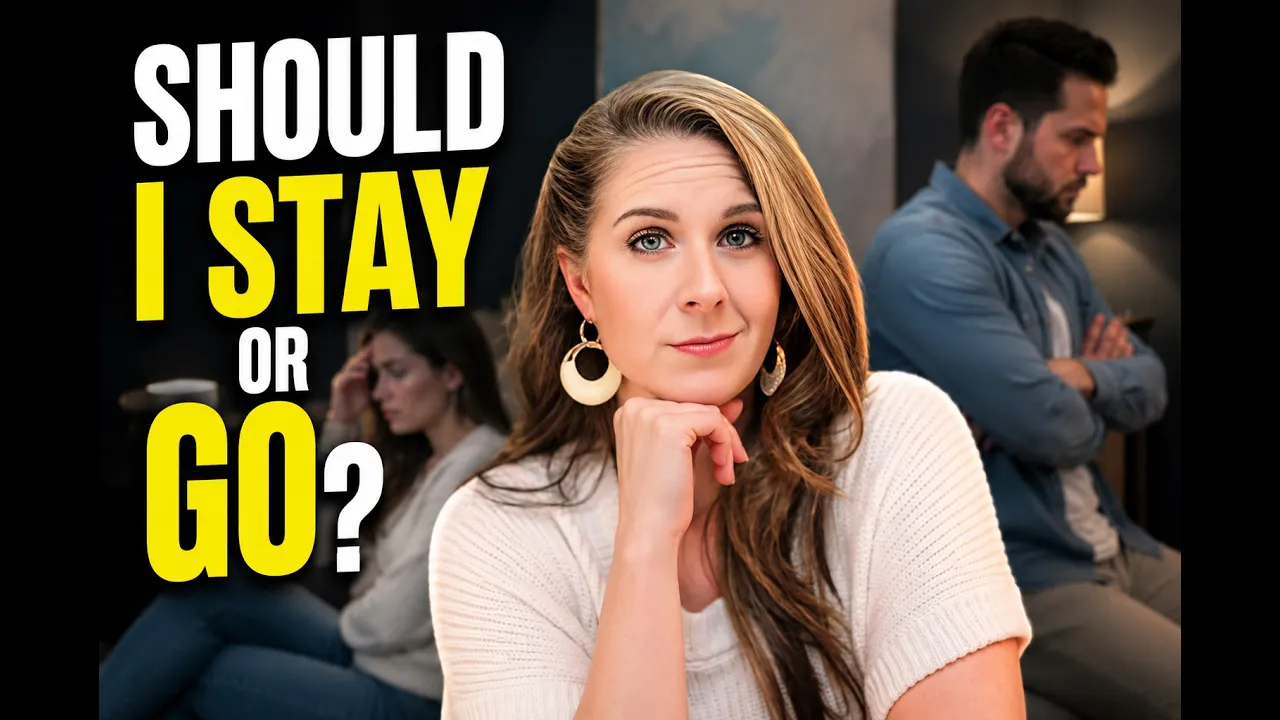
Should I Stay or Should I Go? Here's the Question You Need to Answer First
There comes a point in some relationships where you feel like you've run into the same brick wall so many times that you start wondering if you're losing your mind.
You love this person. The relationship isn't bad all the time. In fact, there are plenty of good moments. But somehow you always end up back in the exact same argument, the same hurt, the same disappointment.
After enough cycles, one question starts to take over:
Is this relationship fixable, or do I need to walk away?
If you're asking yourself that question, you're not alone. It's one of the most common struggles I see, and unfortunately, it's also one of the hardest to get clear answers about.
Everyone Has an Opinion About Your Relationship
When you're hurting, it's natural to reach out.
Maybe you talk to your best friend.
Maybe your family.
Maybe your therapist.
Or maybe you ask a bunch of strangers online because they feel more objective.
You explain what's happening, hoping someone can help you make sense of it. And if you're honest, maybe you're also hoping they'll tell you that you're not the crazy one.
Instead, you often hear the same advice:
-
"Just leave."
-
"He's avoidant."
-
"She's a narcissist."
-
"That's trauma."
-
"Set a boundary and move on."
-
"People don't change."
Sometimes that advice feels validating because someone finally sees how painful your situation is.
But other times it feels like people have skipped over the complicated parts and jumped straight to the ending.
Because you know something they don't.
You Can See the Real Problem
Most people don't stay in difficult relationships because they enjoy suffering.
They stay because they can see what's underneath the behavior.
Maybe your partner struggles with anxiety they refuse to address.
Maybe insecurity turns into jealousy.
Maybe alcohol has quietly become the center of everything.
Maybe their family constantly crosses boundaries and your partner never stands up to them.
Whatever it is, you can see the issue.
And deep down you believe:
"If they would just deal with this one thing, everything else would get better."
The problem is...they don't.
They minimize it.
They blame you.
They acknowledge it for five minutes and then go right back to doing the same thing.
Now you're left wondering:
How long do you wait for someone to face something they refuse to look at?
The Question Isn't "Should I Stay?"
After more than 20 years working with families affected by addiction and denial, I've watched people try everything imaginable.
They've explained.
They've pleaded.
They've yelled.
They've backed off.
They've given ultimatums.
They've become more supportive.
They've become less available.
And somehow they still end up having the exact same conversation months later.
That's when people usually ask:
"Should I stay or should I go?"
But I actually think that's the wrong question.
The better question is this:
Is what I'm dealing with actually fixable?
There's a Huge Difference Between a Toxic Person and a Toxic Pattern
These two situations look almost identical on the surface.
Both involve conflict.
Both involve hurt.
Both leave you feeling exhausted.
But they are not the same thing.
Sometimes you're dealing with someone who truly lacks empathy, refuses accountability, manipulates everyone around them, and has no interest in changing.
If that's what you're dealing with, leaving may absolutely be the healthiest decision.
But sometimes something very different is happening.
Two people become trapped inside a defensive cycle.
Every argument brings out the worst version of both people.
One withdraws.
The other chases.
One becomes defensive.
The other becomes desperate.
One shuts down.
The other gets louder.
Eventually neither person looks like themselves anymore.
The relationship starts looking toxic, even though what you're really seeing is a toxic pattern.
That's an important distinction because patterns can often be changed. Character usually doesn't.
Why It's So Hard to Know the Difference
One of the biggest challenges is that almost everyone giving you advice is only hearing one side of the story.
They love you.
They want to protect you.
So naturally they interpret everything through that lens.
That doesn't necessarily make them wrong.
But it also doesn't automatically make them right.
When two people are locked in a defensive cycle, both of them often behave in ways that don't reflect who they really are.
Someone can look selfish when they're overwhelmed.
Someone can look emotionally unavailable when they're flooded with fear.
Someone can seem uncaring simply because they're stuck in survival mode.
That's why labels alone rarely answer the question.
Before You Decide, Remove Defensiveness
Here's something I've learned from working with people in the deepest forms of denial imaginable.
The biggest obstacle usually isn't the problem itself.
It's defensiveness.
People simply can't hear difficult truths while they're busy defending themselves.
That's why the way you approach hard conversations matters just as much as what you're trying to say.
When defensiveness comes down, something interesting happens.
You finally get to see who you're actually dealing with.
If they're willing to listen...
If they become curious...
If they begin taking responsibility...
You may be looking at a relationship problem that can actually be repaired.
But if you approach them in a healthy, non-defensive way and they still refuse to look at themselves...
Now you've learned something important.
That's no longer just a relationship problem.
That's a character issue.
And that changes the decision you're making.
This Isn't About Staying at All Costs
I want to be very clear about something.
If you're in a relationship where there's abuse, fear, intimidation, or control, this isn't the situation I'm talking about.
Your safety comes first.
Please reach out for support.
This conversation is for relationships that are painful, frustrating, and stuck—but not dangerous.
Relationships where you genuinely believe there's still something worth fighting for if you could just figure out how to get through.
A Different Way to Approach the Problem
Throughout my career helping families navigate addiction, I've learned something that surprises people.
The issue that's keeping someone stuck is often less about what you're confronting and more about how you're confronting it.
When you change the approach, people often respond differently.
I'll be honest, it feels completely backwards at first.
It goes against your instincts.
But when you stop triggering defensiveness, you finally get real information instead of automatic reactions.
Even if your partner never changes, something important still happens.
You change.
You stop operating from exhaustion.
You stop second-guessing yourself.
You gain clarity because you know you've approached the situation in the healthiest way possible.
And whether you ultimately decide to stay or leave, you'll be making that decision from a place of strength instead of burnout.
What We'll Cover Next
In this series, we're going to answer the questions most people never get satisfying answers to:
-
How do you tell the difference between a toxic person and a toxic pattern?
-
Why does trying harder often make things worse?
-
Why is it so difficult to leave, even when part of you knows you probably should?
-
What actually works when someone refuses to acknowledge the problem?
-
How do you approach difficult conversations without triggering defensiveness?
If you've been living with the same relationship problem over and over again, this series was created for you.
The answer isn't always as simple as "leave."
But it's also not always "keep trying."
The goal is to help you figure out which situation you're actually in, so whatever decision you make, you'll know you made it with clarity instead of confusion.
Ready to Go Deeper?
If you're tired of having the same conversations and getting nowhere, keep following this series. We'll walk through practical strategies for breaking through defensiveness, recognizing unhealthy patterns, and making relationship decisions with confidence instead of fear.
Amber Hollingsworth
Watch this next:
🆓 FREE Downloadable Resources: Get instant access to guides, checklists, and tools to support your recovery journey.
💡 Advanced Skills Membership for people with addicted loved ones. Learn advanced strategies to help your addicted loved one while protecting your own peace of mind. https://www.familyrecoveryacademy.online/hff-membership
🤖 Amber AI - Your On-Demand Recovery Coach: Get 24/7 access to personalized recovery coaching anytime, anywhere. https://www.familyrecoveryacademy.online/amber-ai
🙋🏻♀️ Join Our FREE Facebook Group for people with addicted loved ones: Connect with other families navigating addiction in our private community. https://www.facebook.com/groups/familyrecoverysupport
📆 Schedule a Consultation: Speak with one of our family recovery specialists to create a personalized plan. https://www.familyrecoveryacademy.online/consultations
🎯 Strength-Based Recovery Coaching with Amber: Work directly with me to break out of the addictive cycle using a personalized, strengths-based approach. https://www.familyrecoveryacademy.online/strengths-based-assessment